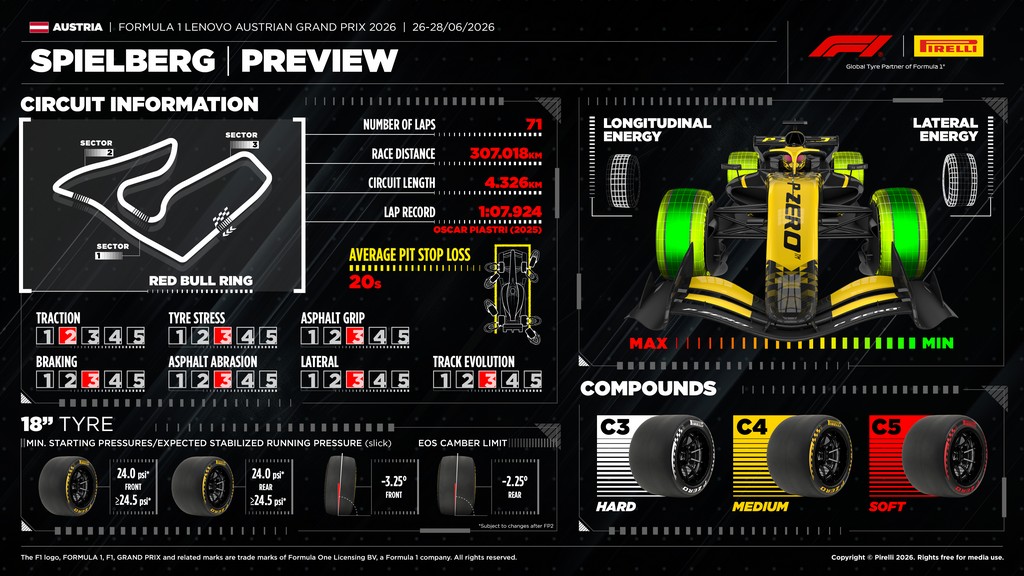
Formula 1 heads to Red Bull’s home turf this weekend, as teams compete in the Austrian Grand Prix at the Red Bull Ring, a 4.326 km circuit with just ten corners. The Austrian track is fast, characterised by elevation changes and heavy braking, and sits 660 metres above sea level. It is a so-called ‘stop and go’ layout, where braking and acceleration phases follow in quick succession.
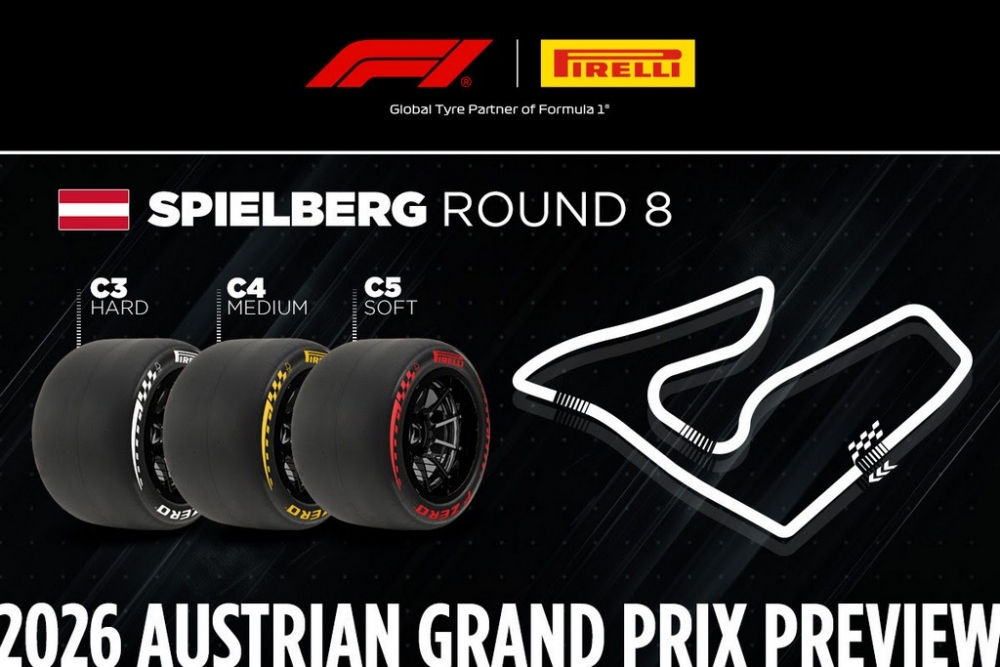
At Spielberg, Pirelli will bring the softest compounds in the range: C3, C4 and C5. Wear is not a decisive factor in Austria, where degradation is mainly thermal in origin. The asphalt is several years old and therefore features high levels of micro- and macro-roughness which, in itself, generates heat in the tyres.
Grip is good thanks to the rubber laid down by the numerous motorsport events hosted by the circuit throughout the year and improves over the course of the weekend, as the track evolves significantly and enhances car performance.
The traction zones also place stress on the rear tyres, which are more prone to degradation. However, drivers will need to pay attention to the front axle under downhill braking. The Red Bull Ring has an elevation change of 63 metres, making it the second circuit for altitude variation. The new power units could deliver enough power to induce locking precisely under these downhill braking phases.
Another key aspect relates to the circuit’s altitude. At over 600 metres, the thinner air results in lower downforce on the cars, which may lead to increased tyre slip.
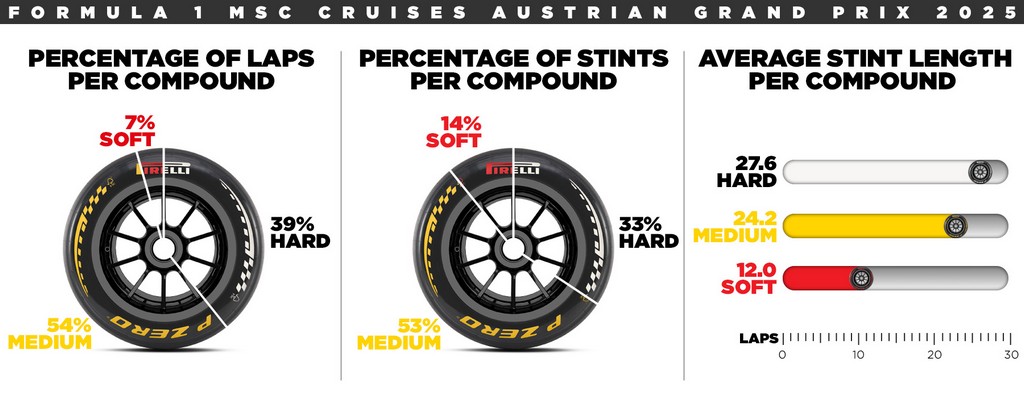
Last year, most teams completed the race with two pit stops and all three nominated compounds were used during the Grand Prix. With the greater consistency of the current tyres, a stronger trend towards a one-stop strategy could be expected.
Temperatures will also be a factor. In late June they could be high, approaching Barcelona levels. However, the circuit is located in a mountainous area of Styria and the surrounding forests can sometimes create conditions for sudden changes in weather.
IN 2025
Last year’s Spielberg race was largely decided by two-stop strategies. Soft and Medium were the main choices on the starting grid: five drivers opted for the C5, while the others selected the C4. The drivers who finished on the podium completed their middle stint on the Hard compound before reaching the chequered flag on Medium tyres. Strategies adopted by the rest of the field varied, based on the sets of tyres available for Sunday.
STATISTICS
The Austrian Grand Prix will be staged for the 39th time. After the first race held at Zeltweg in 1964, the event moved near its current location in 1970. Eighteen editions took place at what was then known as the Österreichring until 1987; subsequent races were held after a ten-year hiatus. At the Red Bull Ring, Formula 1 also staged two editions of the Styrian Grand Prix in 2020 and 2021, organised to address calendar challenges during the Covid-19 pandemic. Max Verstappen is the most successful driver at the Austrian Grand Prix with four victories, one more than Alain Prost. McLaren is the most successful constructor with seven wins, followed by Ferrari and Mercedes on six.