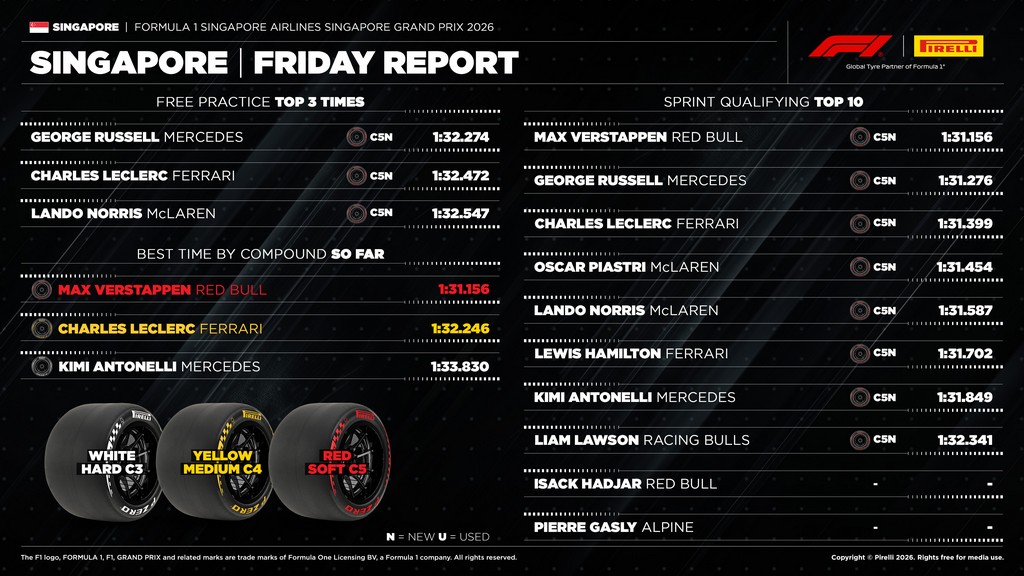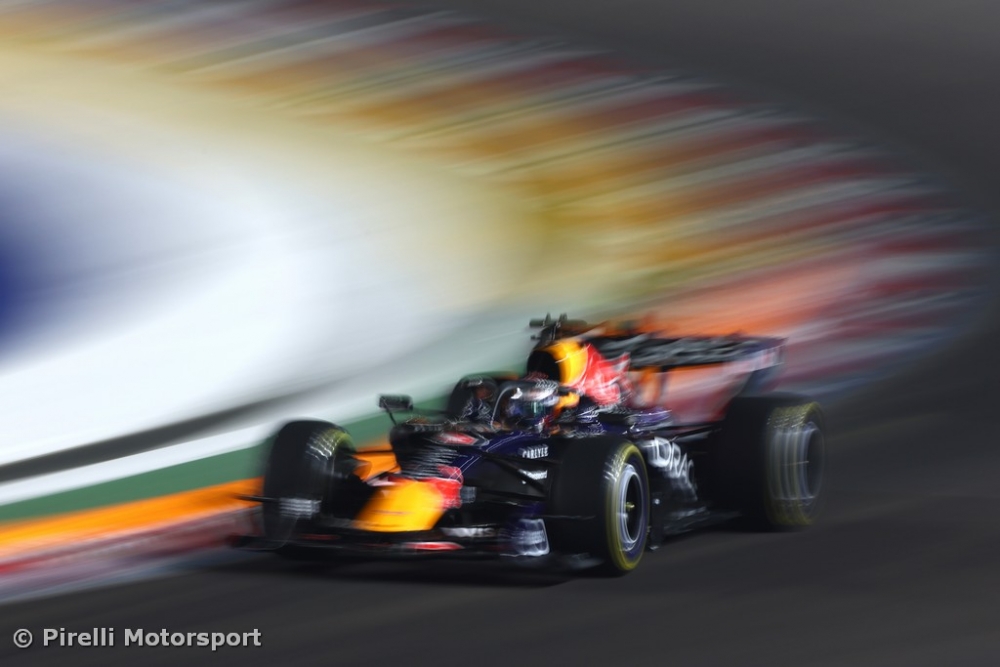
The Dutchman completed a single flying lap on that set, and the time proved enough to keep George Russell behind in second place. Charles Leclerc finished third.
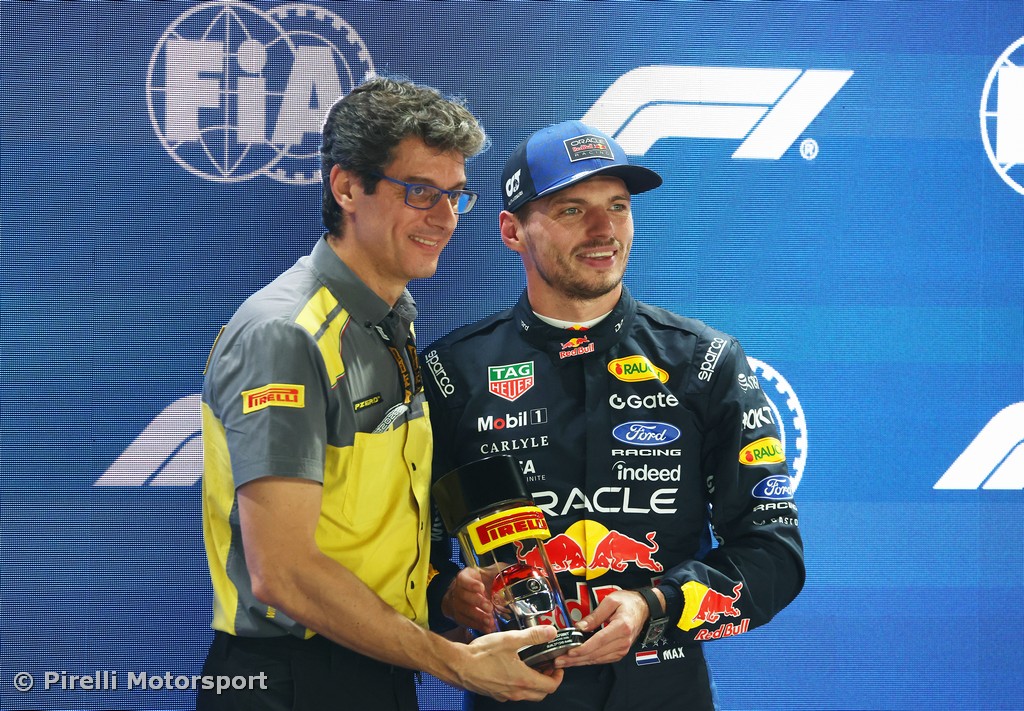
Verstappen stopped the clocks at 1m31.156s, while Russell recorded a 1m31.276s. The Mercedes driver completed two flying laps on the same set of new tyres, setting his best time on the second attempt, as did Leclerc. Russell opted for a sequence of one flying lap, two cool-down laps and then a second flying lap, while the Ferrari driver chose one flying lap, one cool-down lap and then a second attempt.
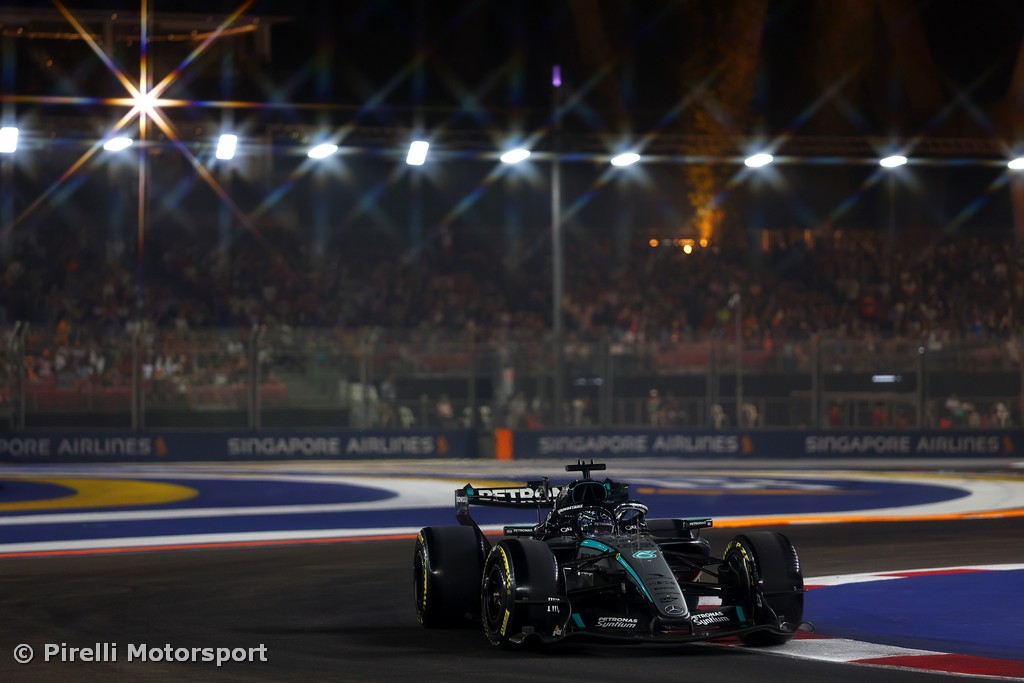
Russell was also fastest in FP1 on the C5 compound. The Mercedes driver posted a 1m32.274s lap. Behind him were Charles Leclerc and Lando Norris, both of whom set their respective best times on the softest compound in the range.
Max Verstappen finished the opening track session in sixth place, the fastest of the drivers who set their best lap on the Medium compound. Nico Hülkenberg was the only driver to record his best performance on the Hard tyre. The C3 was used extensively, with all 20 drivers running the compound during the opening hour of track action.
The street circuit still required rubber to be laid down during FP1, and track evolution was particularly significant along the racing line throughout the session. With this being a Sprint weekend, teams focused much of their work on qualifying simulations, devoting less attention to race pace runs.
SIMONE BERRA – PIRELLI CHIEF ENGINEER
“The level of track evolution was very significant from the very first session. If the circuit continues to improve at this rate, it is entirely possible that lap times tomorrow could be even quicker than initially forecast.
From a tyre perspective, the factor that most differentiated the teams was warm-up. The combination of a green track and relatively low energy levels made temperature management more challenging for some teams, regardless of tyre compound. Others, however, were able to bring the tyres into the correct operating window very quickly, allowing them to push from the very first flying lap in qualifying.
Today, teams focused more on single-lap performance than race pace because, with moderate temperatures and limited degradation, qualifying is likely to carry greater importance than race management. Between the C4 and C5 compounds, we measured a performance delta of around eight to nine tenths of a second, which is broadly in line with our expectations.
One interesting aspect was the different approaches to qualifying lap preparation. Every team and driver adopted different strategies in terms of managing their attempts and cooling the tyres, while still extracting the best lap time available to them.
It highlights just how different the cars and driving styles are, and how they can therefore require different approaches while still maximising the potential of the C5. Balance and the ability to bring the front axle up to temperature quickly were certainly key factors today.
Looking ahead to tomorrow’s Sprint, both the Medium and Soft compounds appear to be viable options. This could lead to a split in strategy and add another interesting dimension to the short race.”