
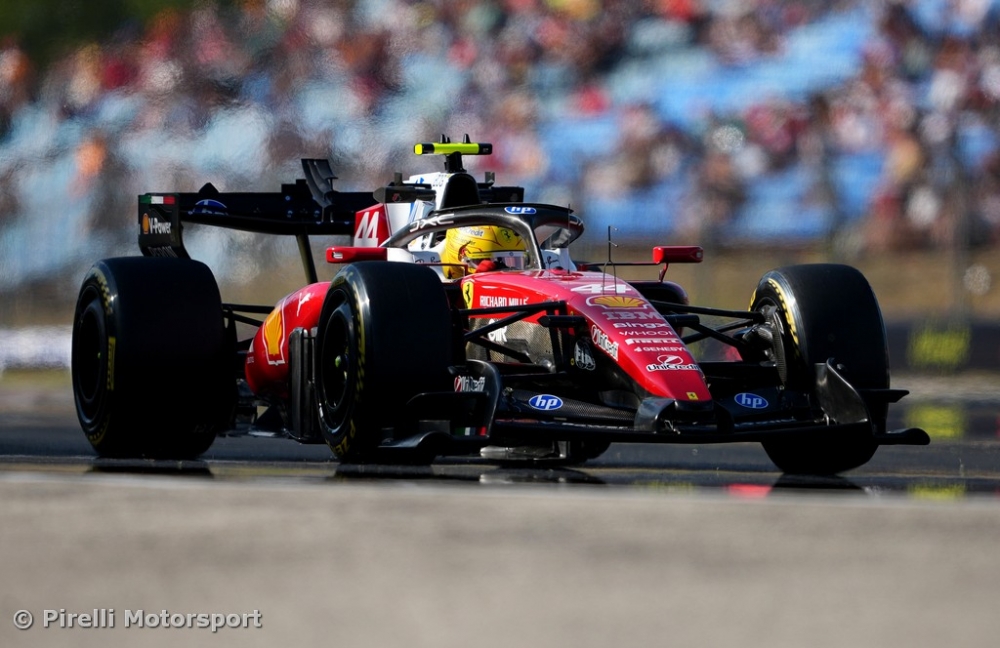
Not only did the Ferrari drivers top the timesheets across the two hours of track action, they also proved to be the quickest on both the Soft and Medium compounds.
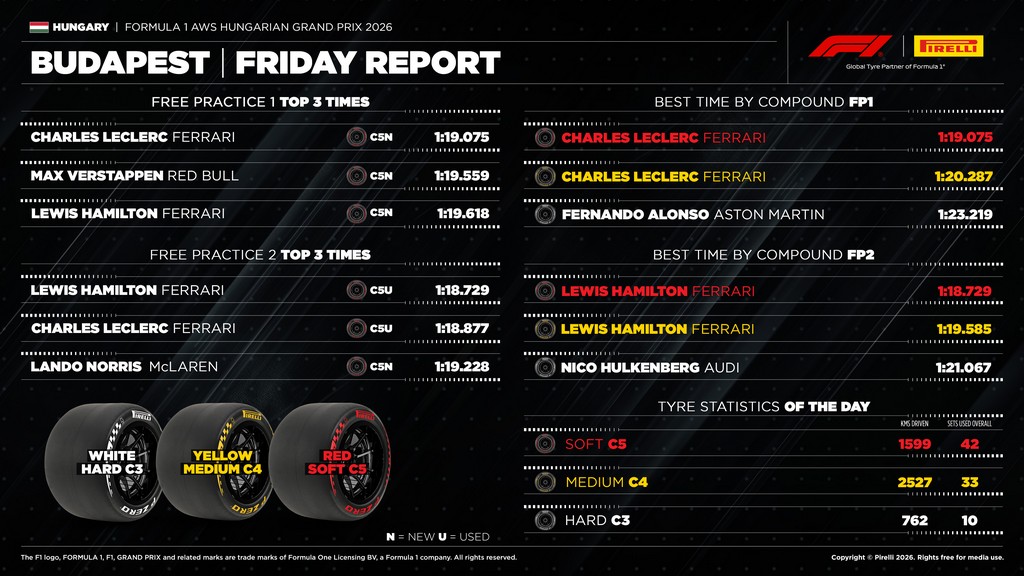
In FP1, the majority of drivers opted for the Medium (C4) tyre for their initial runs, while only the two Cadillacs and the Aston Martins took to the track on the Hard (C3). Towards the end of the session, Leclerc set the benchmark time on the Soft (C5), stopping the clocks at 1:19.075. The Monegasque also led the way on the C4 with a lap of 1:20.287.
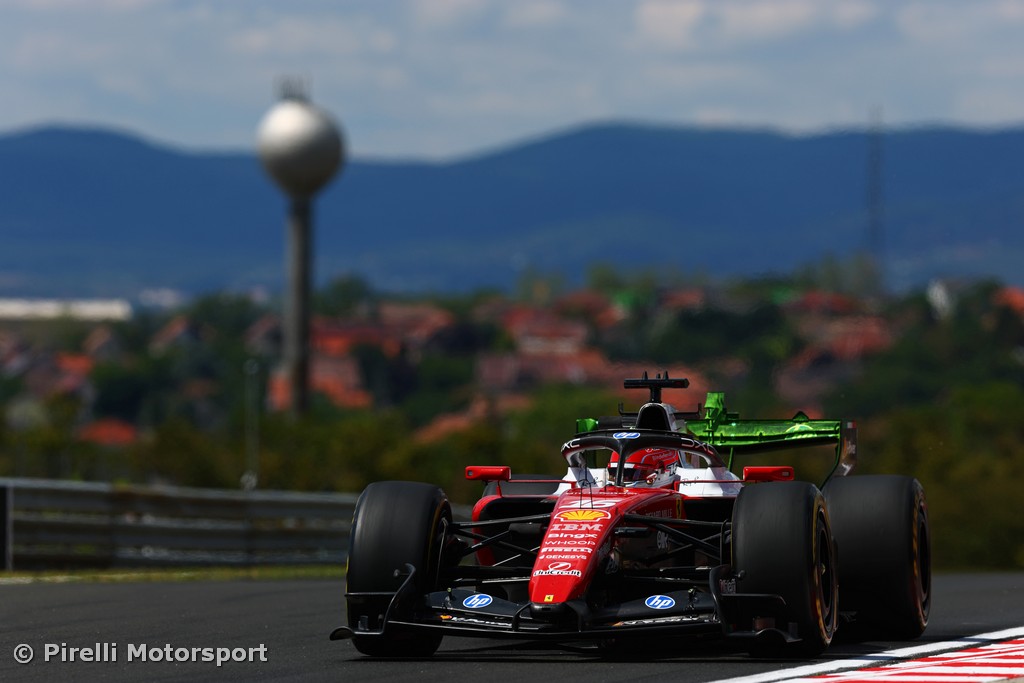
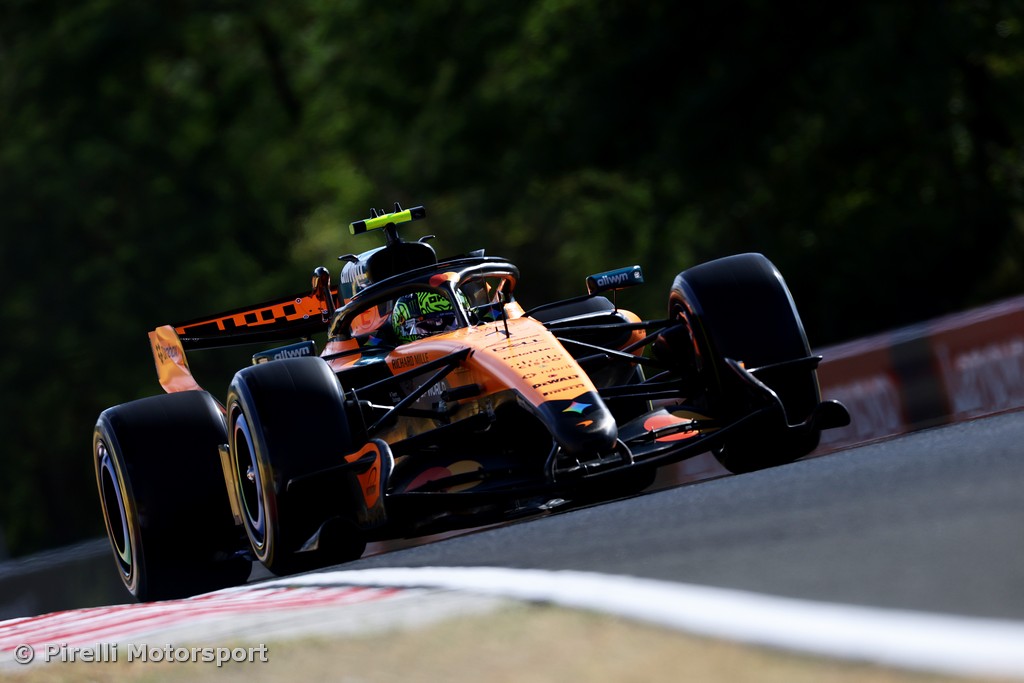
In the second session, it was Ferrari team-mate Lewis Hamilton who finished on top with a time of 1:18.729, again set on the Soft compound. He was followed by Leclerc and Lando Norris, both also running on the red-walled tyre. The seven-time World Champion was also the fastest driver on the Medium in the same session, posting a 1:19.585.
During the opening phase of FP2, the focus was largely on the Hard and Medium tyres. Alex Albon completed the highest number of laps on a set of C3s, covering 26 tours, while George Russell and Valtteri Bottas each managed 23 laps on the C4. Among those who ran the Soft, Leclerc was the most productive, completing 18 laps on the C5.
Ambient temperatures remained around 25°C, while track temperatures peaked at 46°C. Very similar conditions are expected for tomorrow’s qualifying session.
SIMONE BERRA – PIRELLI CHIEF ENGINEER
“We will get a clearer picture tomorrow once the teams have completed their analysis of today’s data, but the indications from the opening two hours of free practice suggest there is still uncertainty over the number of pit stops we are likely to see in Sunday’s race. Six teams have retained two sets of Hard tyres, while all the others have already used at least one, a sign that there is not yet a unanimous view on the best way to tackle the Hungarian Grand Prix.
Given the higher level of degradation observed during the second session, when the drivers pushed harder, a two-stop strategy appears capable of offering an advantage over a one-stop race. However, the difficulty of overtaking at the Hungaroring must also be taken into account, as track position remains a decisive factor at this circuit.
Track grip was relatively low throughout the day, and the Soft proved to be the compound that best showcased the performance of the cars, thanks to the greater mechanical grip it delivered from the very first laps. By contrast, the Medium showed a degree of graining on the front-left tyre.
In general, protecting the rear axle is crucial at this circuit, while managing an inevitable level of front tyre degradation, which should nevertheless decrease as the track continues to evolve over the course of the weekend. The performance gap between the Soft and Medium compounds was around eight tenths of a second, in line with pre-event simulations. Attention now turns to the opening phase of qualifying tomorrow, where it will not be easy for the drivers to identify the optimal window for both the preparation lap and the flying lap on such a short circuit.”
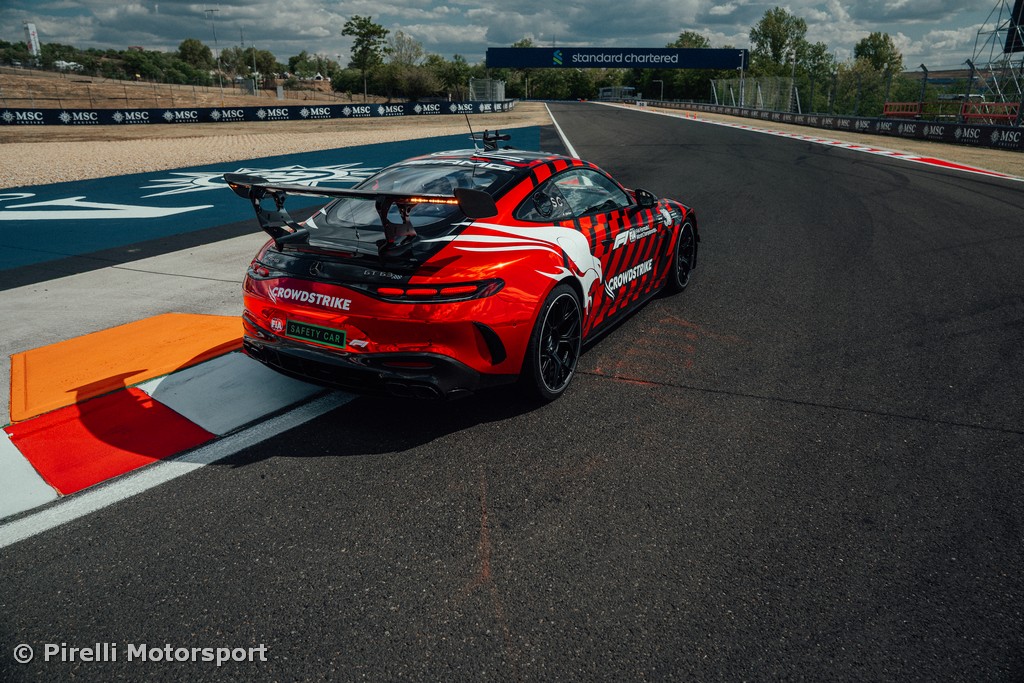
In the FIA garages today, the new official FIA Formula 1® Safety Car made its debut: the Mercedes-AMG GT 63 PRO 4MATIC+, fitted with bespoke P Zero R tyres.
Specifically developed for the Mercedes-AMG GT 63 PRO 4MATIC+, recently unveiled as the first-ever Official FIA F1® Safety Car with fully variable all-wheel drive, the new Pirelli P Zero R is an ultra-high-performance tyre engineered to deliver outstanding track performance and precise steering feel, while also ensuring confident handling in wet conditions.
This double capability is the result of a bespoke dual-tread compound and a tread pattern specifically tuned for this car, developed by Pirelli using Virtual Design techniques in close collaboration with Mercedes-AMG engineers.
The tyre – the first P Zero R tailor-made for a Mercedes-AMG – underwent extensive testing at the Nürburgring and Nardò, with Bernd Mayländer and other expert Safety Car drivers, who praised the tyre’s consistent performance and grip across a wide range of conditions.